20 Good Facts For Choosing Anti-Termite Control Services In Jakarta
Wiki Article
Post-Construction Termite Barrier In Jakarta
A majority of Jakartans think that termite barriers should be put in place prior to making concrete walls and pouring concrete. This belief is expensive. Property owners are told that chemical trenching is the only option after the slabs are cast. This notion is no longer true, as retrofit physical barriers are able to be constructed using the perimeter excavation method and are mechanically attached to existing foundations. The barriers used after construction aren't any less effective than the ones used prior to construction. Both technologies are distinct and have differing performance characteristics. Jakarta anti termite services which can't provide both are excluded from the fastest-growing segment of the market for urban insect control.
1. Physical Barriers Exist and Are Retrofittable
Installation of stainless steel mesh, soil granules that are bonded or polymer membranes infused with slow-release pesticides is possible on existing structures. This involves excavation around the perimeter soil removal as well as the construction of a barrier, and mechanical fixation to the wall. It is disruptive, costly, and long-lasting. Jakarta exterminators who claim that liquid injections on an annual basis is the only available option misrepresent the technology.
2. Liquid Barriers Degrade; Physical Barriers Do Not
In Jakarta, hydrolysis occurs quicker when termiticides are put on the soil. High temperatures, intense rainfall and alkaline pH in the wet months reduces active ingredient half life by a few months. Physical barriers, such as mesh sheets, sheet, and graded stone do not degrade. They work the same way upon being removed in year 10 as well as year 1. Chemical barriers are less effective to clients who are willing to pay more to ensure the permanence of their protection.
3. The Benefit of Moisture Reduction is Not Publicized
Polymer sheet barriers simultaneously exclude termites and suppress capillary moisture migration from the soil to the masonry. Drier foundations mean drier timber. The wood that is drier is not detectable. Termites cannot attack wood they cannot see. Anti-termite companies that offer physical retrofits offer two treatments at a price of one.
4. Partial Perimeter Is Not a Barrier
Jakarta's dense urbanization, party wall, adjacent structures and paved rights-of-way makes full perimeter excavation difficult. Companies offering protection against termites that claim to offer partial installations under the heading "barriers," are misleading about the physics that underlies subterranean access. Termites can walk around the exposed edges. The proper term is "partial perimeter intervention" with documented exclusion gaps. The homeowners should be informed of what gaps remain unprotected.
5. The Bekasi Adoption Signal
Physical retrofit systems have entered the Jakarta extended metropolitan area. Greenfield construction pioneers aren't located in Menteng or Kebayoran. Instead, they are located in Bekasi. Jakarta exterminators are likely to miss the trend if they concentrate on only central Jakarta tenders. Physical barriers are adopted in the cities of secondary importance and then moves to the north.
6. Architect Specification Wins Over Contractor Substitution
Emporio Architect and similar firms are now requiring physical barriers in the renovation documents. The contractor is responsible for providing anti-termite services within this value stream; they don't control requirements. Pest control companies need to shift their the sales process away from homeowners towards architects and structural engineers. The transaction economics of selling retrofits is to the property owner. Being included in an architect's master specification annuity economics.
7. The Additive Decay Curve favors Infused Chemicals
Liquid Termiticides Applied to Soil are Surface-Deposited and Degraded from Day One. Polymer sheets have additives that were infused into the matrix prior to its manufacture. Depletion occurs at the exposed edge in the pattern of diffusion measured over years. Physical barriers are covered by an assurance that is practical and reliable. Five-year warranties on liquid barriers are speculative.
8. The Excavation's Access Determines Feasibility
Budget is not the only limitation in the post-construction barrier construction. Access to the bucket. The minimum clearance for mini excavators is 60 centimeters from the foundation. Geometrically speaking, properties with no-lot-line constructions, shared driveways, and landscape hardscapes installed directly against the wall are not suitable. Access audits have to be conducted by anti-termite companies prior to the time they are able to quote and not at the time of mobilization.
9. ESG Reporting is the catalyst for Commercial Demand
Indonesian corporations that have committed themselves to sustainability, along with international tenants, green-building certification applicants and Indonesian corporations with sustainability commitments are now tracking the embedded CO2 emissions. Broadcast spraying using liquid termiticides has been documented as a source of CO2 emissions. Physical barrier installation--one-time excavation, mechanical fastening, zero recurrent chemical application--qualifies as emissions reduction. Jakarta exterminators who work for corporate clients in Jakarta have to disclose carbon equivalent disclosures, or lose bids to counterparts.
10. Retrofit barriers require different warranties
The plane of the barrier is guaranteed against termite intrusion. Post-construction barrier systems cannot provide this guarantee, as the barrier only encloses a portion of the perimeter that is accessible. The warranty actually consists of "exclusions from treated zones", and not "protection to entire structure." Homeowners oversold to believe that they are safe have been deceived. Exterminators with detailed documentation of what was installed within the house and the things that are still vulnerable will resolve claims and retain more customers.
The Conclusion
Three trends are convergent in Jakarta three trends are convergent in Jakarta: the documented decrease rate of chemical termiticides that are applied to soil employed in tropical urban environments architects' specifications for permanent physical barriers, and the corporations' demand for pest control methods that are compatible with carbon accounting frameworks. Anti-termite solutions that frame post-construction protection solely as chemical trenching aren't safeguarding market share, they protect obsolescence. The equipment required--mini-excavators, core drills, mechanical fasteners--is capital-intensive but one-time. The required training--soil analysis, access auditing and warranty documentationis extensive but can be transferred. Bekasi was the first city to witness the removal of barriers. It is expected to arrive in Jakarta proper within twenty-four months. Early adopters will have two years of advantage over those who wait to see if customers demand it. The question isn't whether to adopt the capability of retrofitting physical. The question is whether to lead the market or follow it. Have a look at the top jasa anti rayap for blog info including pembasmi rayap kayu, cara membasmi rayap di lemari kayu, rumah rayap, anti rayap untuk kayu, kitchen set anti rayap, penyebab rayap, rayap kecil, pembasmi hama, rayap rumah, jasa anti rayap and more.
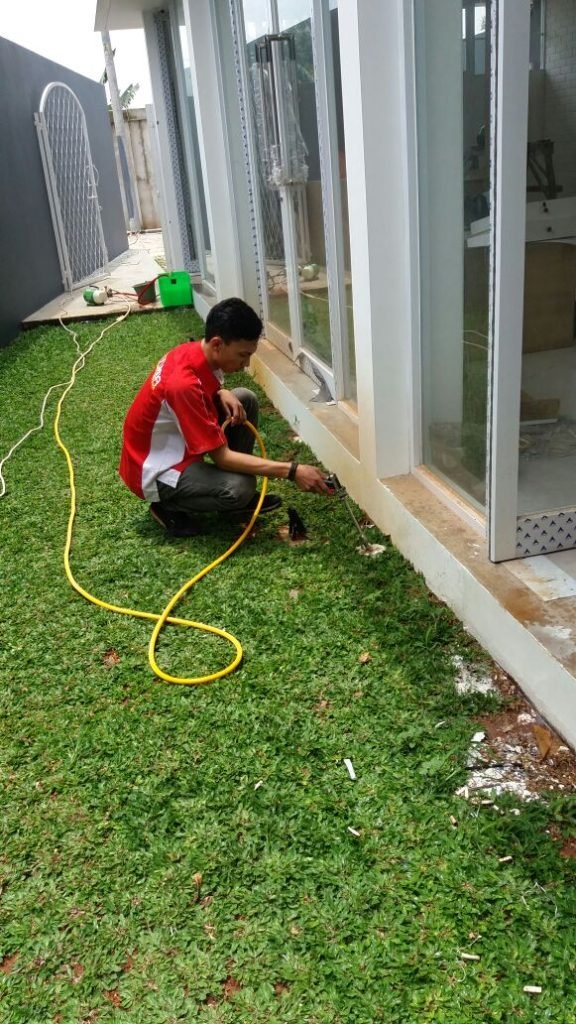
Baiting Above-Ground For Asian Subterraneans At Jakarta
Jakarta residents think that termite-baiting is done by placing plastic bait stations in their gardens, which are then checked periodically by a technician, who examines the area and then shakes his head. This is a form of perimeter monitoring, not colony destruction. Baiting above ground is a totally different field of study. The station will not be buried. Instead it will be secured to a working mud tub or pressed up against the affected area. The bait isn't hidden as it is directly inserted into termites' daily commuting route. For Asian subterranean species--Coptotermes gestroi, Coptotermes curvignathus, Microtermes insperatus--above-ground delivery bypasses every behavioral barrier that makes perimeter baiting slow and uncertain. Jakarta anti termite services without above-ground station in their vehicle are only equipped for inspection and not for treatment.
1. Above-Ground Stations require an active infestation
The technicians set up the stations and look for termites. Above-ground baiting works only if it is confirmed. The station is only deployed after mud tubes or damaged timber are located. This isn't a restriction, it's efficiency. The plastic is not buried in sterile soil. No technician hours are wasted on stations that are not likely to be struck.
2. The Mud Tube is now a delivery infrastructure
Above-ground stations can be designed to complement existing termite-based construction. The base of the station forms an enclosed chamber that is over the mud tube opening. Termites that are traveling from the nest to the feeding site can pass through the station and get into contact with the bait matrix they consume and continue their journey. The tube will not be destroyed. The commuter pattern doesn't become interrupted. The colony makes use of its own infrastructure for poisoning itself.
3. For Above-Ground Deliveries Test for Palatability Is Different
The colony already has a taste test for wood. Now it is possible to determine the feeding site. Aboveground bait matrices are only required to be acceptable. They do not have to look attractive. The formulation is relaxed and can include toxicants that have a slower reaction that would otherwise be rejected because they compete with the adjacent untreated wooden surfaces. Jakarta exterminators should use a variety of bait formulations and select based on the feeding preferences observed in the specific area of infestation.
4. Recruitment Multiplier with Self-Seeding
The feeding process begins as soon as the termites are transferred from the wood into the chamber for recruitment of the above-ground station. The introduced termites have already adjusted to the local environment and foraging rhythm. They start eating bait and attracting nestmates through trophallaxis. This alone can increase the rate of release of the poison by 30. Exterminators dispose of biological resources when they kill the termites after scraping off damaged wood.
5. Coptotermes gestroi Responds Quickly Above Ground
Asian subterranean termites specifically Coptotermes gestroi, keep a high levels of foraging throughout the year. Above-ground bait stations located close to active infestations usually show eating within 48 hours. The timeframe for removing colonies is compressed from weeks to months. Services quoting six-month timelines for above-ground baiting are either using suboptimal matrices or failing to transfer recruiting termites.
6. Microtermes and macrotermes require different places for them.
The termites that produce fungal spores (Microtermes Macrotermes, Microtermes, and Macrotermes Gilvus) don't build mud tubes as extensively as Coptotermes. Their foraging takes place above ground in a more scattered manner, and food sources of these termites are often concealed within wood. These species require the excavation of the damaged zone, direct insertion into the cavity of the feeder and a careful sealing. The geometry of the station is different. Jakarta exterminators attempting Coptotermes strategies against Microtermes infestations may observe low uptake.
7. Moisture Conditioning Is Non-Negotiable
The above-ground bait matrixes are created at certain water activity levels. Jakarta's humidity creates an exchange of moisture with the surrounding environment. Bait stored in a toolbox or in a vehicle for some weeks could dehydrate. Bait taken out of its packaging sealed and then left at the location to absorb water from the atmosphere, can degrade. Exterminators must condition the bait cartridges just before installation. This means adding measured water, in order to reach the optimal moisture level. In the event of a non-useable inventory, it must be protected from the humid climate of Jakarta.
8. Inspection Frequency Comppresses
The inspection process for baiting at the perimeter occurs every quarter or semi-annually. Above-ground baiting takes place on a weekly cycle. Because active infestations consume bait quickly the cartridges that are depleted in a matter of days need to be replaced. Colony destruction is confirmed once the feeding ceases and the the mud tubes begin drying up. If the service plans to look for baits above ground in their regular perimeter monitoring timeframe, they may miss out on colony recovery because they will not see any bait remaining and could believe that treatment has improved.
9. Warranties require different underwriting
Perimeter Baiting warranties are priced based on the density of stations and the frequency of inspection. The price of above-ground baiting guarantee is based on species, the extent of infestation, and the complexity. One Coptotermes gestrii colony that is at the threshold of the front door is covered using normal prices. Microtermes infestations that dispersed across the entire ground floor require distinct risk-based models. Jakarta antitermite companies that apply the same pricing on each scenario, yet provide a standard warranty for both, are mispricing.
10. Above-ground Ground is Not Only Its Therapeutic Value, but also It's also a diagnostic
The location of the tubes of mud, the proportion of castes of termites seen in the stations, and the frequency that the bait is consumed give an indication of the health of the colony and range of foraging. Consumption is rapid and indicative of a large colony that's in stress for resources. Abandonment after consumption indicates the possibility of colony elimination or bait abstention. Intense mud tube darkening indicates reduced traffic. Termite control professionals taught to recognize these signs can alter treatment parameters instantly. The termite exterminators who change cartridges, then leave the premises are not utilizing this most effective method of treatment for termites that is based on data.
You can make your decision by clicking on the hyperlink below.
Above-ground apprehension and identification of Asian subterraneans by inspection companies is not a supplementary service. This is the thing that distinguishes colony removal specialists from inspection firms. Perimeter baiting monitors. Above-ground baiting treats Perimeter-baiting is waiting to be discovered. Above-ground engineers have had issues. Perimeter-baiting is a source of quarterly service tickets. Above-ground treatment results in the destruction of colonies as well as the subsequent renewals of warrantys. Jakarta anti-termite companies that are hesitant to adopt above-ground methods typically point to equipment costs, technician training requirements, or the hassle of carrying multiple bait matrices. These aren’t barriers. They are just investments. The expense of the equipment is expected to be paid back within the first three above ground deployments. The training investment pays off when technicians transition from generalists to specialists. Multiple bait matrixes distinguish the best service providers from common exterminators. The homeowners with active termite infestations do not want perimeter monitoring. The colony has to be eliminated. The above-ground poisoning method is the most effective method to accomplish this. Every day that a Jakarta exterminator is working on the tubes and injecting the soil without the use of above-ground stations. This is the day the colony continues feeding. See the top rated anti rayap jakarta for blog advice including pest control jakarta selatan, cara basmi rayap, cara basmi rayap, pest control jakarta selatan, rayap adalah, jasa anti rayap jakarta, jasa basmi rayap, anti hama, pest control harga, cara membasmi rayap di lemari and more.
